MANAGED IT & HELPDESK
Support that answers when the line stops
The short answer
SafeIT's managed IT and helpdesk gives manufacturers and food and beverage processors 24/7 monitoring of every site and an emergency line answered 24/7 for any business-stopping event, with routine requests handled by phone, email and a dedicated ticket portal, 9:00 to 17:00 local time, Monday to Friday. Line-stopping faults route straight to an engineer. It also covers the routine work plants tend to skip: patching scheduled around production, defined onboarding and same-day offboarding, a live asset inventory and current documentation, to one standard across every site.
Your plant runs three shifts. Most IT providers run one.
That gap shows up at exactly the wrong moment. The label printer stops at 11pm and the only person who knows its IP address is asleep. A new hire starting at 6am has no login because the request went in Friday afternoon. The ERP terminal in shipping locks up during the last load of the day, and the answer is "raise a ticket, someone will look tomorrow."
Tomorrow is not an answer when the truck is at the dock.
So we split it the way a plant would. Any business-stopping event, a line down, a site offline, a suspected security incident, gets a person on the phone 24/7, and every site is monitored around the clock so we often see it first. Routine requests, the password reset and the new starter's laptop, are handled 9 to 5 on weekdays. That is how we keep the emergency line fast and the membership affordable.
The other half of the problem is quieter. Nobody is doing the routine work: the patching, the asset records, the offboarding of the person who left in March and whose account still works. It never causes a crisis on any given Tuesday. It causes a crisis eventually, and by then nobody remembers why the door was left open.
You already solved this problem for safety. Nothing on the floor depends on one person remembering. There is a schedule, a checklist, a record, and somebody accountable. This is that, for IT.
What's included
- 24/7 emergency line, answered by a person, for business-stopping events: a line down, a site offline, a suspected security incident. Real coverage on nights, weekends and statutory holidays, not an answering service that takes a message.
- Helpdesk for routine requests by phone, email and dedicated ticket portal, 9:00 to 17:00 local time, Monday to Friday. If you want routine requests handled around the clock as well, we can build that into your contract. Every contract is priced individually.
- Shift-aware escalation. Line-stopping faults route straight to an engineer. Priority is set by production impact, not by who filed the ticket.
- Dedicated member portal for every incident, ticket and request: searchable, exportable, and usable as governance and audit evidence.
- Patch and update management for servers, workstations and network devices, scheduled around your production calendar rather than a vendor's default Tuesday.
- Onboarding and offboarding as a defined process: accounts, email, licences, enrolment in MFA (a second check beyond the password), hardware, plant-floor terminal access, and a same-day shutdown on departure.
- Asset management. A live inventory of every device, warranty date, licence and end-of-support date: so hardware refresh becomes a budget line, not a surprise.
- Vendor coordination. We chase your internet provider, your ERP reseller and your equipment manufacturer on your behalf, and report back.
- 24/7 monitoring and proactive remediation of servers, endpoints, network and core services at every site, so we catch the disk filling up before it stops a shift.
- Documentation of your environment, kept current: network layout, systems, credentials handling, recovery steps.
- Scheduled strategy check-ins. A standing meeting with someone who knows your plant, covering what broke, what is coming, and what to budget for.
- Multi-site standardization. One program, one standard, one documentation set across every plant you run, in every country you run it in.
How it works day to day
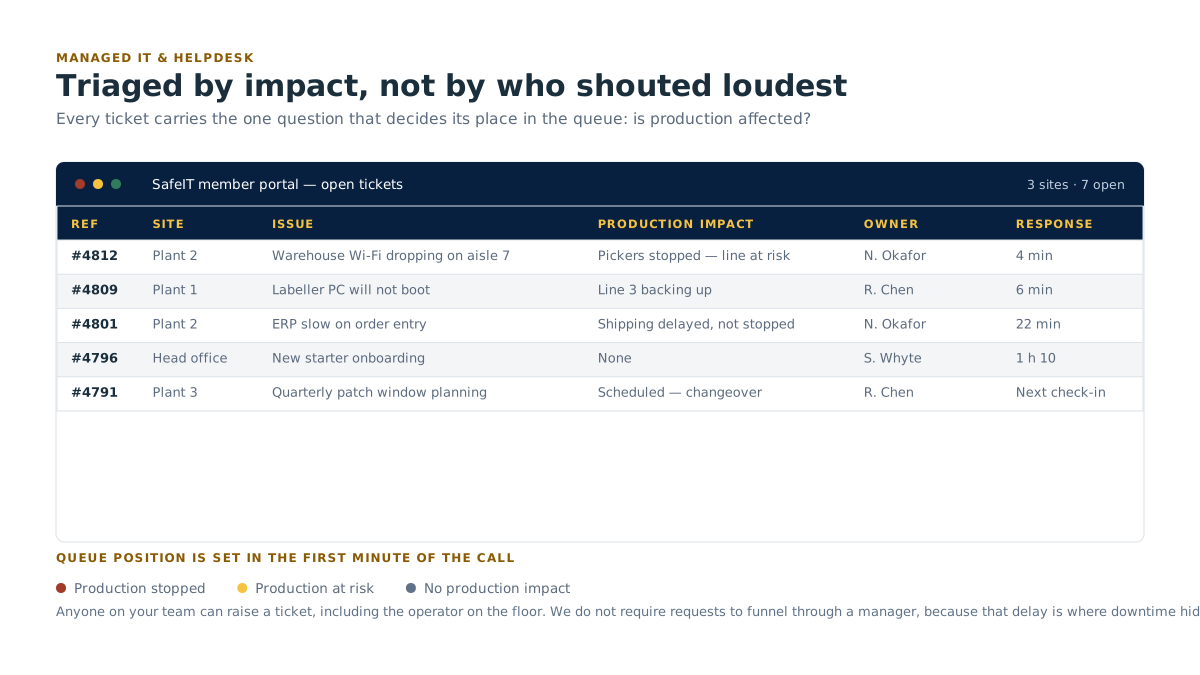
Your crew calls or clicks. One number, one portal, one email address. Anyone on your team can raise a ticket, including the operator on the floor. We do not require requests to funnel through a manager, because that delay is where downtime hides.
We triage by impact. Is production affected? How many people? Is a shipment at risk? That determines the queue position, and it is answered in the first minute of the call.
We fix it remotely where we can, and get someone on site where we can't. Most issues resolve remotely. Cabling, hardware swaps, site surveys and installs get hands on the ground.
We close the loop. Every ticket gets a written resolution in the portal. You can see what was wrong, what we did, and how long it took: per site, per system, per month.
We meet on a schedule. Not just when something breaks. Scheduled check-ins cover recurring faults, end-of-life hardware, upcoming projects and anything your customers or insurers have started asking for.
What this looks like in month one, and in month six
Month 1, Get the noise down and the facts on paper. We onboard, document what you actually have, and take over the queue. Expect a burst of tickets as your team discovers they can finally call somebody. We build the asset inventory, close the accounts that should have been closed, get MFA and patching under control, and identify the three or four things most likely to stop your line. You get a written baseline. Onboarding is waived for members.
Month 6: Fewer tickets, and different ones. Repeat faults are gone because the underlying cause got fixed instead of reset. Ticket volume typically shifts from "it's broken again" toward requests and change work. Your quarterly check-in is about a hardware refresh plan and an integration project, not about the same warehouse access point failing every fortnight. When a customer sends a security questionnaire, you export a portal report instead of writing from memory.
Who this is for
- Plants running more than one shift where support currently ends at 5pm.
- Operations with no internal IT, where the controller or the maintenance manager has quietly become the IT department.
- Operations with an internal IT person who is a single point of failure and has not taken an uninterrupted holiday in years.
- Multi-site manufacturers running different vendors and different standards at each plant.
- Food and beverage processors who need clean records of who had access to what, and when, for customer and regulatory audits.
Delivered by KTI
The helpdesk behind SafeIT is run by Kearns Technology Inc., our parent company: a managed IT provider founded in 2010, headquartered in Toronto, with a team of network technicians, consultants, security experts and analysts serving customers in Canada, the United States, the United Kingdom and Germany.
Published performance: average response time under 30 minutes, and 100% of service level agreements met over the last six quarters.
KTI's existing work includes unifying multi-site IT under a single corporate program and supporting a highly dispersed workforce: which is the same problem a two-plant manufacturer has, in a different building.

Do we get a named person, or a random tech every time?
You get a team, with named engineers who know your plant and sit in on your check-ins. That is deliberate. One named person who knows everything is a single point of failure, the same trap you are trying to get out of. The portal and the documentation mean whoever picks up at 3am can see your environment immediately.
Can our operators raise tickets directly, or does it have to go through a manager?
Directly. We set up whatever access makes sense on the floor: a phone number on a laminated card by the terminal, a shared email, a QR code on the noticeboard. Waiting for a supervisor to relay a fault costs you minutes you do not have.
Will you work with our existing IT person?
Yes. We take the helpdesk, the after-hours emergencies, the patching, the offboarding and the vendor chasing, and they keep the plant knowledge and the improvement projects. In our experience, internal IT people are usually relieved rather than threatened, because they get to stop carrying the pager alone.
Is the ticket portal really usable as audit evidence?
Yes, and this is more useful than it sounds. When a customer, an insurer or a certification body asks how you manage IT incidents and access changes, you export a report showing every incident, who handled it, how fast, and how it was closed. That is a documented process with records, which is exactly what an auditor is looking for.
What this means for your plant
Somebody qualified answers at 3am when the line is down, and line-stopping faults jump the queue. The routine work, patching, accounts, asset records, gets done on a schedule, not when someone remembers. Every ticket is logged in a portal you can hand to an auditor.
Related
- Pairs with Network & infrastructure: most plant-floor tickets are network tickets underneath.
- Pairs with Business continuity & disaster recovery: the helpdesk is who you call when you need the recovery plan run.
- See also Cyber resilience and Cloud & business software.
- Membership: this service is delivered as a membership; onboarding is waived for new members.
- Book a free assessment: we review your current support arrangement and tell you plainly where it falls short, including after hours.
- All services · Contact