BUSINESS CONTINUITY & DISASTER RECOVERY
How long can you not ship?
The short answer
SafeIT sets recovery targets for each system by asking how long the plant can go without shipping, then backs them with Datto: a local appliance for fast restores, an off-site copy, and the ability to run critical servers from the backup while the originals are rebuilt. Restores are tested on a schedule, with measured recovery times reported against those targets.
That is the only continuity question that matters, and almost nobody in IT asks it.
Ask most providers about backup and you will get a description of nightly jobs and retention periods. Useful information, wrong question. The question your business actually needs answered is: if the ERP is gone on Monday morning, when do trucks start moving again? Tuesday? Friday? And how much of last week's data comes back with it?
Here is what we find in most plants. Backups are running. Green ticks in a console. Nobody has ever done a full restore. The one person who knows the restore process is the person who set it up. The plan, if there is one, is a document from four years ago that names two people who no longer work there. And the backup lives on a device sitting in the same building as the servers it is backing up: which is fine, right up until the flood, the fire, or the ransomware that encrypts the backup too.
You have a fire drill. You have an evacuation route posted by every exit. You practise it, and you know it works because you have walked it. Continuity should be held to exactly that standard: written down, walked through, and proven.
What's included
- Recovery targets set in plant terms. Two numbers, per system. RTO, recovery time objective: how long until it is back. RPO, recovery point objective: how much work you lose. We set them by asking how long you can go without shipping, and how much re-keying your team can absorb.
- Datto-backed backup and continuity. Local appliance for fast restores, replicated off site, with the ability to run critical servers from the backup while the original is being rebuilt.
- Coverage of what actually matters: the ERP, the MES that tracks production, file servers, email and Microsoft 365, quality and batch records, CAD and drawings, the machine-adjacent PCs, and the legacy systems other providers skip.
- Immutable and off-site copies so ransomware cannot encrypt your recovery.
- Tested restores on a schedule. We restore real systems, record the time it took, and report it against your targets. If we miss the target, that is a finding, and we fix the design.
- Ransomware recovery capability: isolate, identify the clean recovery point, rebuild, restore, and get production back before touching the rest.
- A written recovery runbook in plain language, ordered by what gets you shipping first. Printed, and stored somewhere that does not require the network to read.
- Tabletop exercises with your team: operations, finance, quality and leadership, not just IT.
- Communications planning: who tells your customers, who tells your staff, who tells your insurer, and in what order.
- Cork coverage for every SafeIT member, warranty-backed cyber financial protection alongside the technical recovery.
- Annual review of the plan against how your business has changed. New site, new ERP, new customer requirement, the plan changes with it.
What recovery actually looks like
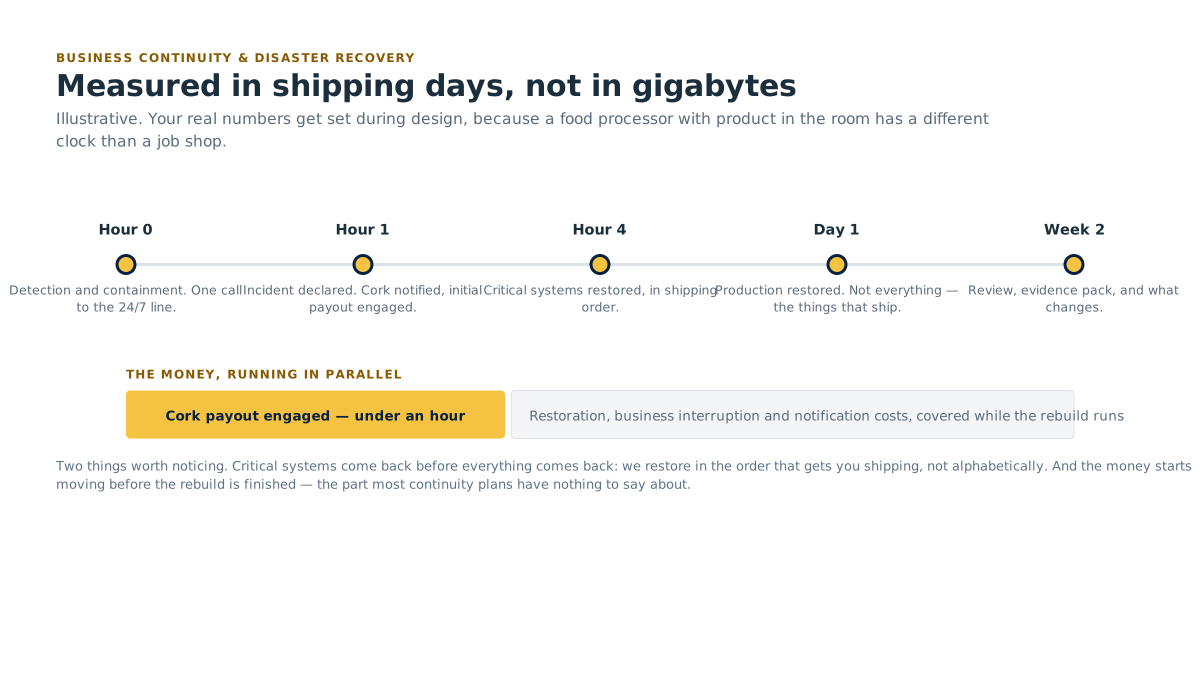
The timeline above is illustrative. Your real numbers get set during design, because a food processor with product in the room has a different clock than a job shop.
Two things are worth noticing in it. First, critical systems come back before everything comes back: we restore in the order that gets you shipping, not in alphabetical order. Second, the money starts moving before the rebuild is finished. That is the Cork line, and it is the part most continuity plans have nothing to say about.
How it works day to day
Backups run and are verified. Every job is checked, and a failed backup is a ticket, not a line in a report nobody reads.
Restores are tested to a schedule: including full-system restores, not just a file pulled back from yesterday. You get the test results and the actual measured recovery times.
The runbook stays current. New server, new site, new ERP module: the plan gets updated at the same time, not at the next annual review.
Tabletops are run with humans in the room. We put a scenario in front of your team, ransomware on Monday at 6am, a flooded server room, an ERP corruption discovered mid-shift, and walk it through. Every tabletop we run finds something. Usually it is a phone number nobody has, or an assumption that the plant can run on paper when it cannot.
When it happens for real, one call starts everything. 24/7 emergency line: (+1) 866 853 2767
What this looks like in month one, and in month six
Month 1, Find out whether your backups work. We inventory what is being backed up and, more importantly, what is not. Then we do the thing that almost never gets done: we attempt a restore. That single test usually produces the most valuable finding of the engagement. We set your RTO and RPO targets with your operations team, get the Datto appliance in and replicating, and write the first version of the runbook.
Month 6, You have proof, not hope. Restores have been tested more than once, with measured times against your targets. Your team has run at least one tabletop and knows their part. The runbook is printed and in the right hands. Cork coverage is in place. When a customer or insurer asks about your disaster recovery arrangements, you send documented evidence instead of a paragraph of reassurance.

Who this is for
- Any plant whose backups have never been restored under pressure. That is most plants.
- Food and beverage processors with product at risk, where a lost shift is also lost inventory.
- Operations with contractual delivery commitments and penalties for missed windows.
- Manufacturers whose customers or insurers are now asking for documented recovery plans and testing evidence.
- Anyone who has already had a ransomware scare and does not intend to have a second one.
- Multi-site operators who need consistent recovery standards, not a different arrangement at each plant.
Technical recovery gets the line running. Cork covers the hit while it does.
Recovery costs money before insurance settles anything. Overtime. Emergency freight. Temporary equipment. Specialists. Warranty-backed cyber financial protection moves faster than a claims process, which is precisely when the cash is needed, and it is included with membership rather than sold as an add-on.
Coverage activates once onboarding brings your environment up to Cork's required baseline. How Cork coverage works, in full →
Delivered by KTI, backed by Datto
Continuity is delivered by Kearns Technology Inc., our parent company and delivery engine, on the Datto platform. Ransomware data recovery is established work in KTI's practice, alongside supporting critical logistics systems: real recoveries, not a slide about them.
Datto is used because it does the two things a plant needs: fast local restore, and the ability to run a critical server directly from the backup appliance while the original is rebuilt. Shipping continues while the repair happens in the background.
We already back up to a NAS in the server room. Isn't that enough?
It covers the case where a file gets deleted. It does not cover fire, flood, theft, or ransomware, all of which reach a device sitting in the same room on the same network. You need an off-site copy, and you need at least one copy that cannot be altered or encrypted even by an attacker with your administrator password.
How long does recovery actually take?
It depends on what you protect and how you design it, which is why we set targets before we design anything. A plant that has invested in fast local restore and can run critical systems from the appliance is typically shipping again the same day. A plant restoring from off-site copies alone, with no local appliance, is measured in days. We tell you which one you are buying, and what the difference costs.
Do you cover Microsoft 365? Our data is in the cloud already. Yes, and you should. Microsoft keeps the service running; it does not indefinitely keep your data safe from your own deletions, a compromised account, or a retention policy nobody noticed. Cloud data needs backing up like anything else. See cloud and business software.
What about the old machine PCs that can't run backup software?
We image them and hold a tested restore path, and where possible run a virtual copy. That is part of legacy and critical-system continuity, and it is deliberately in scope. The systems most likely to stop your line are often the ones least likely to be in a standard backup job.
What this means for your plant
Your recovery target is set in shipping days, agreed with operations, not chosen by IT. Restores get tested and timed, so you know the plan works before you need it. Cork's initial payout starts in under an hour, while the technical recovery is still running.
Related
- Pairs with Legacy & critical-system continuity: old systems need imaging and a restore path too.
- Pairs with Cyber resilience: detection and containment are the first two steps on the recovery timeline.
- See also Managed IT & helpdesk and Cloud & business software.
- Membership: Cork coverage and waived onboarding come with membership.
- Cork coverage
- Book a free assessment: includes a review of your current backups and whether a restore has ever been tested.
- All services · Contact